By The Myanmar Narrative Think Tank
Executive Summary
President U Min Aung Hlaing’s official visit to Malaysia in October 2026 marks an important development in Myanmar–Malaysia relations and regional diplomatic engagement. Undertaken at the invitation of Malaysian Prime Minister Dato’ Sri Anwar Ibrahim, the visit provided an opportunity to strengthen cooperation in trade and investment, transnational security, migrant worker welfare, and policy research. Over two days of discussions in Putrajaya and Kuala Lumpur, the two governments explored practical ways to advance shared priorities.
From a strategic policy perspective, the visit offers a constructive model for regional cooperation based on dialogue, sovereign equality, and mutual respect. As Myanmar develops its institutions following the elections and ASEAN advances its community vision, closer cooperation between Nay Pyi Taw and Kuala Lumpur could help create favorable conditions for Myanmar’s full participation in regional and international institutions.
Historical Ties and Regional Partnership
Myanmar and Malaysia share historical experiences of colonial rule and independence in the mid-20th century. They established diplomatic relations in 1958, laying the foundation for a longstanding partnership. Looking ahead to the 70th anniversary of diplomatic relations in 2028, both leaders agreed to begin preparations to commemorate this shared history and explore new opportunities for cooperation.
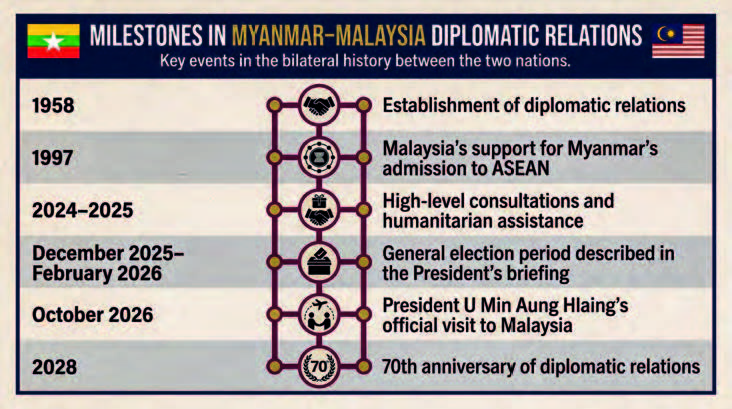
| Period | Milestone |
| 1958 | Establishment of diplomatic relations |
| 1997 | Malaysia’s support for Myanmar’s admission to ASEAN |
| 2024–2025 | High-level consultations and humanitarian assistance |
| December 2025–February 2026 | General election period described in the President’s briefing |
| October 2026 | President U Min Aung Hlaing’s official visit to Malaysia |
| 2028 | 70th anniversary of diplomatic relations |
Malaysia’s support for Myanmar’s accession to ASEAN in 1997 remains an important milestone in the relationship. That spirit of regional cooperation was reaffirmed during the October 2026 visit. Prime Minister Anwar Ibrahim emphasized Myanmar’s importance to ASEAN cohesion and Malaysia’s commitment to maintaining constructive and candid diplomatic relations. Building on earlier exchanges in Thailand and China, the Putrajaya discussions underscored the value of sustained dialogue and mutual understanding.
Domestic Political and Institutional Developments
Myanmar’s evolving political and institutional landscape formed an important part of the discussions. President U Min Aung Hlaing briefed the Malaysian delegation on the implementation of Myanmar’s political roadmap, including the multiparty general election held between December 2025 and February 2026. He also outlined the work of the Third Pyidaungsu Hluttaw, which is holding parliamentary sessions to address matters of public interest within the constitutional framework.
The President reaffirmed the government’s commitment to building a stable Union based on democracy and federalism, taking account of Myanmar’s domestic circumstances. These institutional developments provide a basis for further dialogue with international partners on opportunities for closer engagement.
Prime Minister Anwar acknowledged the complexities of governing a diverse, multi-ethnic society and emphasized the importance of understanding each country’s circumstances. He also welcomed Myanmar’s humanitarian cooperation, including access for Malaysian field hospitals following the recent earthquake. These exchanges highlighted the potential for practical cooperation to strengthen trust and support humanitarian objectives.
Economic Cooperation and Regional Connectivity
Trade and investment were central to the visit, with discussions highlighting the scale of existing economic ties and opportunities for further expansion. The economic figures cited in the discussions placed annual bilateral trade at more than US$1.6 billion and identified Malaysia as Myanmar’s fourth-largest trading partner and ninth-largest investor among 48 countries and territories investing in Myanmar.
Existing bilateral agreements on the avoidance of double taxation, investment protection, air services, and science and technology provide a foundation for expanding cooperation.
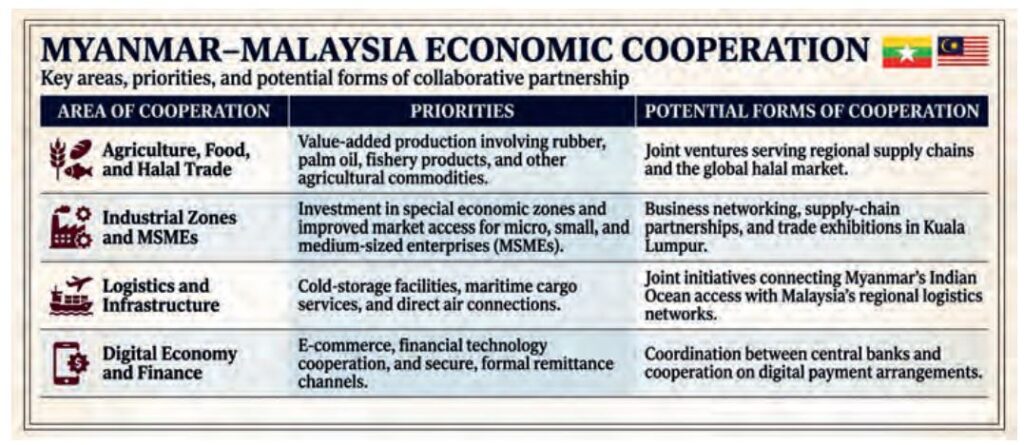
| Area of Cooperation | Priorities | Potential Forms of Cooperation |
| Agriculture, Food, and Halal Trade | Value-added production involving rubber, palm oil, fishery products, and other agricultural commodities | Joint ventures serving regional supply chains and the global halal market |
| Industrial Zones and MSMEs | Investment in special economic zones and improved market access for micro, small, and medium-sized enterprises | Business networking, supply-chain partnerships, and trade exhibitions in Kuala Lumpur |
| Logistics and Infrastructure | Cold-storage facilities, maritime cargo services, and direct air connections | Joint initiatives connecting Myanmar’s Indian Ocean access with Malaysia’s regional logistics networks |
| Digital Economy and Finance | E-commerce, financial technology cooperation, and secure, formal remittance channels | Coordination between central banks and cooperation on digital payment arrangements |
President U Min Aung Hlaing highlighted the complementary strengths of the two economies. Myanmar provides links to the Bay of Bengal and South Asia, while Malaysia is an established maritime trade and manufacturing hub within ASEAN. Connecting Myanmar’s natural resources and special economic zones with Malaysian investment, industrial expertise, and logistics capacity could help develop more resilient regional value chains and create opportunities for businesses in both countries.
Migrant Worker Welfare and Repatriation
Labor cooperation and migration management were key priorities in the Putrajaya discussions. With more than 160,000 documented Myanmar nationals working in Malaysia’s manufacturing, construction, plantation, and service sectors, both governments emphasized worker welfare and effective migration arrangements.
President U Min Aung Hlaing called for stronger implementation of bilateral memoranda of understanding on labor cooperation. Priorities included safe and regular labor migration pathways, workplace safety, fair remuneration, and protection against exploitative recruitment practices. The Myanmar delegation also expressed appreciation for the welfare and healthcare support provided to Myanmar workers by the Malaysian authorities.
The two leaders discussed consular cooperation and arrangements to facilitate the return of Myanmar nationals held in Malaysian immigration facilities. Prime Minister Anwar welcomed Myanmar’s commitment to covering the full cost of repatriating its nationals. According to the account presented during the visit, more than 10,493 citizens had already returned by chartered flights and naval vessels.
President U Min Aung Hlaing confirmed that naval vessels would be dispatched when maritime conditions permitted, following verification of the nationals eligible for return. Continued coordination between the two governments can improve the efficiency of these arrangements while safeguarding the dignity, safety, and rights of returning nationals.
Cooperation Against Transnational Crime
Both leaders recognized that narcotics trafficking, online fraud, and human trafficking are interconnected regional challenges requiring coordinated action. Their discussions highlighted opportunities to strengthen law enforcement cooperation, information sharing, and assistance to victims.
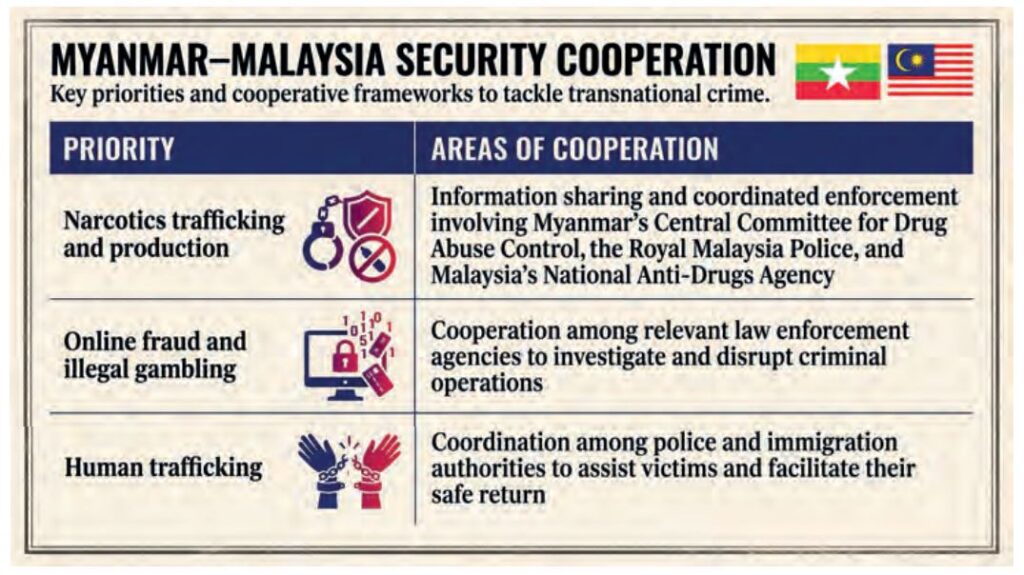
| Priority | Areas of Cooperation |
| Narcotics trafficking and production | Information sharing and coordinated enforcement involving Myanmar’s Central Committee for Drug Abuse Control, the Royal Malaysia Police, and Malaysia’s National Anti-Drugs Agency |
| Online fraud and illegal gambling | Cooperation among relevant law enforcement agencies to investigate and disrupt criminal operations |
| Human trafficking | Coordination among police and immigration authorities to assist victims and facilitate their safe return |
President U Min Aung Hlaing outlined Myanmar’s legal and operational measures against online fraud, including legislation enacted on 31 July to address online scams and illegal gambling. He stated that criminal networks had established operations in remote border areas beyond effective government control, including areas controlled by ethnic armed organizations.
The President also described operations to dismantle scam compounds and destroy contraband in coordination with neighboring countries. Cooperation among Myanmar’s Central Committee for Drug Abuse Control, the Royal Malaysia Police, and Malaysia’s National Anti-Drugs Agency provides a channel for exchanging information and coordinating enforcement. These efforts also support the rescue and return of foreign nationals, including Malaysians, affected by trafficking and related criminal activities.
Policy Dialogue and Research Cooperation
A notable feature of the visit was the attention given to policy research and dialogue among think tanks. Alongside official discussions, the Malaysia–Myanmar Cooperation Dialogue at the Prime Minister’s official residence provided a forum for examining bilateral priorities and longer-term opportunities.
The forum was organized by the Institute of Strategic and International Studies (ISIS Malaysia) and the Myanmar Institute of Strategic and International Studies (MISIS). The Myanmar Narrative Think Tank also delivered a presentation and participated in the discussions, contributing analysis, strategic perspectives, and policy recommendations.
Such exchanges can complement government-to-government diplomacy by bringing research and professional expertise to discussions on trade, labor, security, and regional cooperation. Continued interaction among officials, researchers, and academic institutions can help translate shared priorities into practical proposals and sustain dialogue beyond individual high-level visits.
Advancing Regional and International Engagement
President U Min Aung Hlaing’s official visit underscores the contribution that direct dialogue and practical partnership can make to regional cooperation. The discussions on political and institutional developments, trade, migrant worker welfare, repatriation, and transnational crime provide a constructive agenda for continued engagement between Myanmar and Malaysia.
The institutional developments outlined during the visit strengthen the case for a review of international engagement with Myanmar. ASEAN should move toward restoring Myanmar’s full political participation, while the United Nations should give renewed consideration to the credentials of the delegation nominated by the newly constituted government. This position rests on an assessment of changing circumstances, the interests of Myanmar’s people, and the practical benefits of international cooperation.
Prime Minister Anwar Ibrahim’s invitation and the resulting dialogue demonstrate the value of sustained engagement in addressing shared regional priorities. By engaging Myanmar at the highest political level, Malaysia has contributed to a constructive environment for further cooperation within ASEAN. Regional partners should build on this momentum by supporting Myanmar’s full participation in ASEAN summits and high-level decision-making bodies, expanding trade and investment links, and working together for lasting peace and prosperity across Southeast Asia.
Sources
[1] Transcript of President U Min Aung Hlaing’s speech at the joint press conference.
[2] Transcript of Prime Minister Anwar Ibrahim’s speech at the joint press conference.
[3] Global New Light of Myanmar: “Heads of State of Myanmar and Malaysia hold bilateral talks, meet media personnel” (October 9, 2026)
[4] Global New Light of Myanmar: “President U Min Aung Hlaing calls for Myanmar-Malaysia relations to reach next level” (October 9, 2026)
[5] BERNAMA: “Malaysia, Myanmar Agree On Bilateral Talks Follow-up, Including Refugee Issue – Anwar” (October 8, 2026)
[6] BERNAMA: “Malaysia, Myanmar Agree To Strengthen Bilateral Ties – Anwar” (October 8, 2026)
[7] BERNAMA: “Myanmar President Leaves For Home After Official Visit To Malaysia” (October 8, 2026)
The views expressed in this article are solely those of MNTT