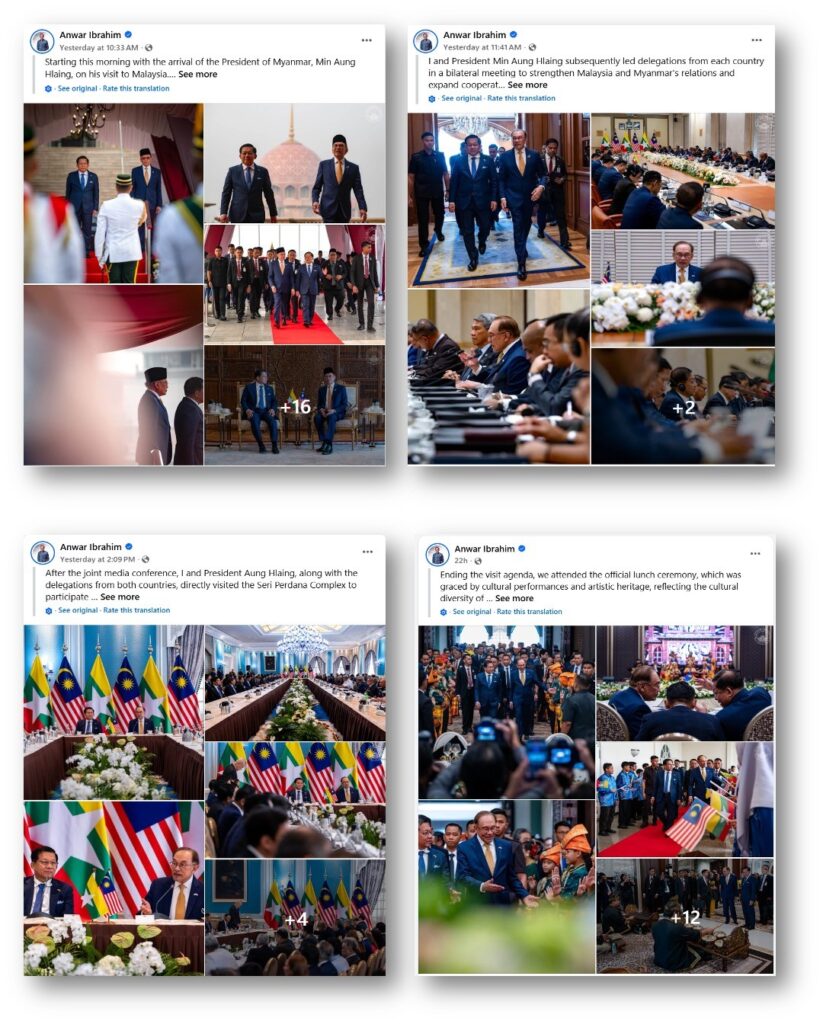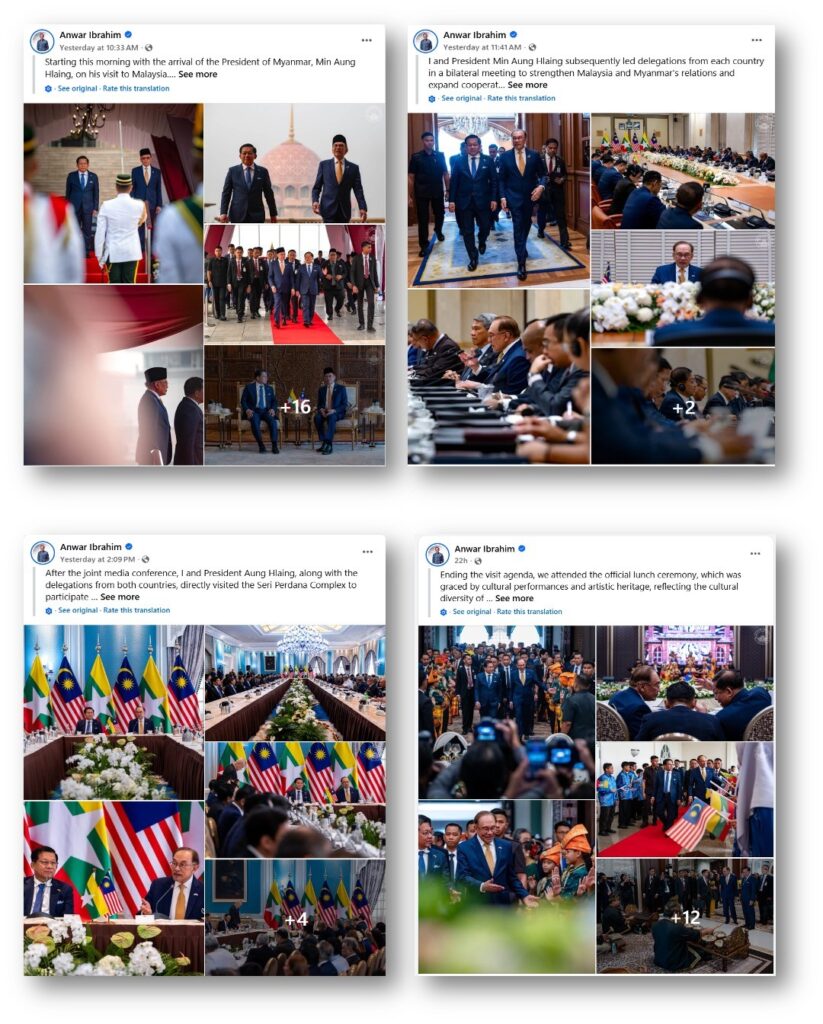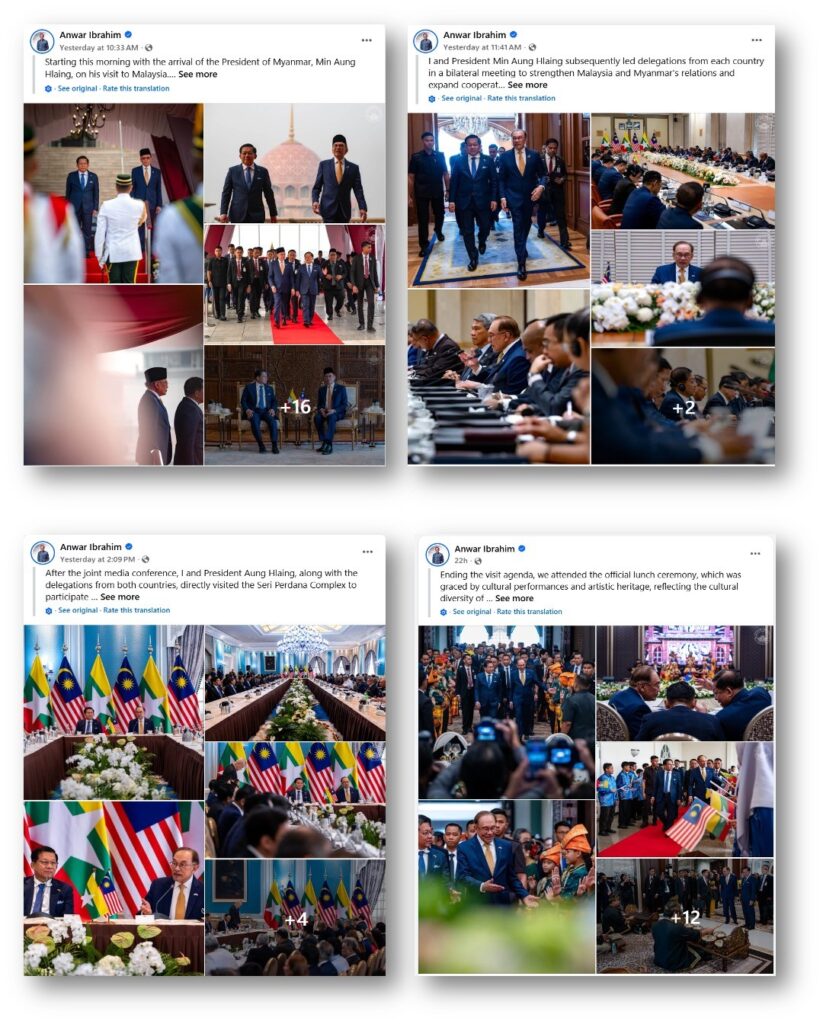
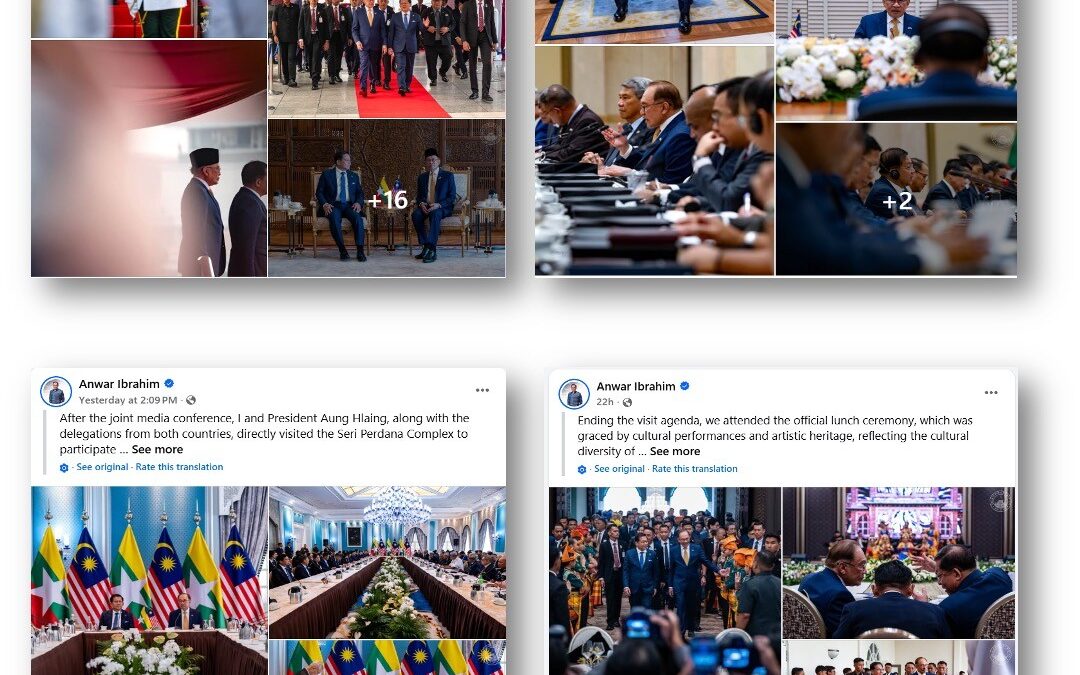
1. Myanmar President U Min Aung Hlaing paid an official visit to Malaysia from 7 to 8 October 2026 at the invitation of Malaysian Prime Minister Anwar Ibrahim. He attended the Myanmar–Malaysia Trade and Investment Cooperation Forum, held discussions with the Malaysian Prime Minister, and participated in Malaysia–Myanmar cooperation dialogue sessions.
Myanmar–Malaysia Trade and Investment Cooperation Forum
2. The Myanmar–Malaysia Trade and Investment Cooperation Forum was held at the InterContinental Kuala Lumpur hotel on 7 October 2026, from 1430 to 1600 hours. Conducted in two sessions, it was attended by 80 representatives from the Union of Myanmar Federation of Chambers of Commerce and Industry (UMFCCI) and Malaysian business organisations.
3. During the first session, UMFCCI President U Aye Win delivered opening remarks, followed by Vice-President U Wai Phyo’s presentation, “Myanmar Economy at a Glance.” The presentation noted that bilateral trade in the 2025–2026 financial year totalled US$1.60 billion, comprising approximately US$175 million in Myanmar exports to Malaysia and US$1.42 billion in Malaysian imports to Myanmar. Discussions therefore focused on reducing the trade deficit and increasing Myanmar’s exports.
4. Proposed cooperation included producing and exporting value-added agricultural, rubber and fisheries products by combining Myanmar’s resources with Malaysia’s technology, industrial expertise and market access; joint investment in the Thilawa Special Economic Zone and other industrial zones; and solar and Battery Energy Storage System (BESS) projects. Support for Malaysian investors would include market and legal information and assistance in connecting with industrial zones and local partners.
5. During the second session, President U Min Aung Hlaing invited Malaysian businesses to regard Myanmar as a long-term partner in production, investment and regional supply chains, rather than solely as a market. He outlined protections under Myanmar’s business and investment laws and referred to the pursuit of stability and peace. He encouraged cooperation using Myanmar’s raw materials and Malaysia’s technologies in agriculture, livestock, manufacturing, education, healthcare and pharmaceuticals, with access to markets including China and India. He also proposed a broader Myanmar–Malaysia Business Forum, invited Malaysian businesspeople to visit Myanmar under the principle “Seeing is Believing,” and offered to host a future forum in Myanmar.
6. Malaysian business associations and companies presented sector-specific opportunities:
(a) MMC Ports. Cooperation in port management, transport and logistics infrastructure.
(b) IOI Corporation Berhad. Cooperation in agriculture, palm oil, value-added production and supply chains.
(c) FMM (Federation of Malaysian Manufacturers). Local assembly, joint production and regional supply chains in agro-processing, automation, packaging, cold chains and logistics.
(d) Revolution Technology Group. Smart factories, automation, robotics, digitalisation, renewable energy and BESS to improve industrial energy reliability and efficiency.
(e) NCCIM (National Chamber of Commerce and Industry of Malaysia). Business-to-business connections and expanded trade and investment.
(f) Southern Steel Berhad. Steel production and supply for construction and infrastructure, joint domestic processing and manufacturing, and technology transfer.
Discussions between the Two Countries’ Leaders
7. The two leaders held an extended Myanmar–Malaysia bilateral meeting at the Prime Minister’s Office on 8 October 2026, from 1000 to 1045 hours. They discussed:
(a) Bilateral Relations and Diplomatic Cooperation. Strengthening friendship and diplomatic relations, organising programmes for the 70th anniversary of diplomatic relations in 2028, and increasing government engagement.
(b) Economic Cooperation and Investment. Expanding trade and investment and cooperation in agriculture, livestock, fisheries, energy and technology through business forums, micro, small and medium-sized enterprises (MSMEs), and digital trade.
(c) Education, Healthcare and Tourism. Scholarships, student and teacher exchanges, research, human resource development, medical technology, healthcare services, tourism and people-to-people links.
(d) Labour Affairs. Protecting the rights, safety and social security of Myanmar workers; ensuring legal and orderly employment; and facilitating visas and work permits.
(e) Repatriation of Myanmar Nationals. The Malaysian side expressed gratitude for Myanmar’s repatriation of its nationals from Malaysia by air and sea. Both sides discussed continuing to repatriate those remaining through appropriate means after verifying and confirming their citizenship, and cooperating to ensure that they do not become a burden on Malaysia.
(f) Combating Transnational Crime. Joint action against online fraud, human trafficking, drug offences and other transnational crimes; law-enforcement information sharing; and the identification and repatriation of foreign nationals involved in illegal activities.
(g) ASEAN and Matters Concerning Myanmar’s Political Process. They exchanged views and held discussions on the ASEAN Charter, the ASEAN Five-Point Consensus, Myanmar’s political process and election-related matters, election observation, and the continued strengthening of cooperation within the ASEAN framework.
(h) Cooperation on Natural Disasters and Humanitarian Affairs. Malaysia’s search-and-rescue and medical assistance following the 2025 Mandalay earthquake; cooperation in emergency medical care and humanitarian activities; and matters concerning Rakhine State, displaced persons and the readmission of persons whose citizenship had been verified.
(i) Practical Implementation of Bilateral Cooperation. Coordination among relevant ministries to strengthen cooperation in diplomacy, the economy, education, healthcare, technology and security. The President invited the Malaysian Prime Minister and His Majesty the King of Malaysia to visit Myanmar.
Malaysia–Myanmar Cooperation Dialogue
8. The Malaysia–Myanmar Cooperation Dialogue was held at the Seri Perdana Complex, the Malaysian Prime Minister’s official residence, from 1000 to 1215 hours. Government representatives, officials and delegates from MISIS and ISIS Malaysia attended. The dialogue comprised two sessions.
9. During the first session, representatives of ISIS Malaysia, the Malaysia External Trade Development Corporation (MATRADE), the Research Department of the Prime Minister’s Office and the Federation of Malaysian Manufacturers (FMM) discussed:
(a) Diplomatic and Strategic Cooperation. Based on the historic friendship between the two countries, they emphasized strengthening relations not only between governments but also among business people, academics and think tanks; building mutual trust; and pursuing long-term cooperation in education, tourism and skills development.
(b) Trade and Investment. Combining Myanmar’s agricultural and natural resources, including rare-earth elements, with Malaysian manufacturing technology, and expanding investment in energy, halal food, healthcare, pharmaceuticals, infrastructure, construction and green technology.
(c) Security and Labour Affairs. Defence diplomacy, maritime security, action against transnational crime and online scams, disaster relief, humanitarian assistance and labour cooperation.
(d) Regional Economic Cooperation and Digital Technology. Simplifying trade procedures, expanding digital systems, supporting small and medium-sized enterprises, strengthening ASEAN logistics chains and establishing practical long-term business partnerships.
10. During the second session, the chairmen of ISIS Malaysia and MISIS delivered remarks, followed by concluding remarks from the two leaders:
(a) Summary of the Myanmar President’s Remarks. He called for stronger cooperation among governments, businesses, academics and think tanks; increased production and export of value-added agricultural, fisheries and rubber products to reduce the trade deficit; cooperation in energy, logistics and digital finance; and use of both countries’ geographic advantages to expand regional trade, investment and supply chains. He also encouraged closer MISIS–ISIS Malaysia relations through policy dialogues, joint research and exchanges of young academics and researchers.
(b) Summary of the Malaysian Prime Minister’s Remarks. He described his discussions with President U Min Aung Hlaing as positive and emphasized cooperation among relevant ministries in economic, foreign, security, defence, humanitarian, disaster-management, and search-and-rescue affairs, together with increased people-to-people engagement. He expressed support for implementing practical cooperation based on the leaders’ discussions and think-tank recommendations.
Separate Report
11. Up to six posts covering the visit were published in real time on the Malaysian Prime Minister’s Facebook account. The reported topics included:
(a) Myanmar and Malaysian Leaders Meet to Discuss the Repatriation of Myanmar Refugees.
(b) Myanmar and Malaysia Discuss Strengthening Bilateral Relations and Cooperation on Security and Peace.
(c) Myanmar and Malaysia to Strengthen Bilateral Relations and Cooperation on Regional Security and Stability.
(d) Malaysian Prime Minister Emphasizes the Practical Implementation of Malaysia–Myanmar Cooperation.
(e) Attendance at an Official Luncheon during the Myanmar–Malaysia Friendship Visit.
12. Prime Minister Anwar Ibrahim uses social media and news coverage to inform the public about government policies, diplomatic activities and leadership initiatives. His Facebook account covered the visit’s official welcome, private discussions, bilateral meeting, joint press conference, cooperation dialogue and official receptions through posts, photographs and live videos. The media also served to explain government policies, communicate political and diplomatic positions, build public trust and project international images of Malaysia’s leadership.
Summary of Findings
13. The visit sought to strengthen Myanmar–Malaysia relations among governments, businesses, academics and think tanks, including through programmes for the 70th anniversary of diplomatic relations in 2028 and MISIS–ISIS Malaysia policy dialogues, joint research and academic exchanges.
14. Economic discussions focused on reducing the trade deficit and expanding value-added production by combining Myanmar’s agricultural, fisheries and natural resources with Malaysian technology and investment. Priority areas included palm oil, manufacturing, ports, logistics, automation, renewable energy and regional supply chains.
15. Security and labour discussions addressed online scams, human trafficking, drug offences and other transnational crimes; protection of Myanmar workers’ rights, safety and social security; legal and orderly labour migration; and the verification and repatriation of Myanmar nationals.
16. Regarding cooperation on ASEAN, peace and humanitarian affairs, they discussed Myanmar’s political process, the ASEAN Five-Point Consensus and regional cooperation. It was observed that the Malaysian Prime Minister emphasized inclusive peace dialogues, the protection of civilians, the safe delivery of humanitarian assistance, and enabling refugees to return home voluntarily, safely and with dignity. It was also observed that discussions during the visit focused primarily on renewing and strengthening bilateral diplomatic relations, expanding economic and technological cooperation, and jointly addressing security and humanitarian issues.