By Ko Ko Hlaing
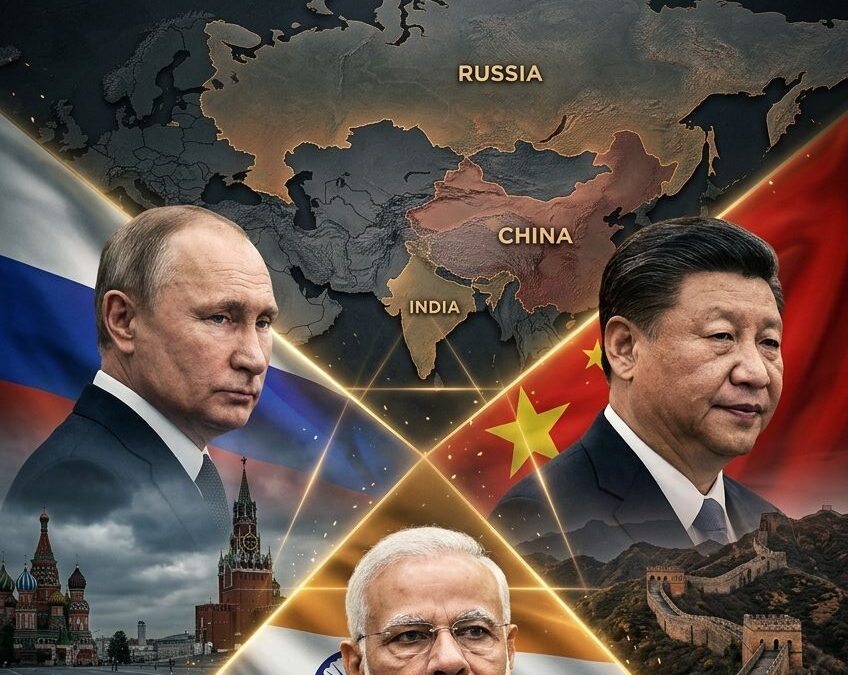
Russia, China and India—three of the world’s major powers—play exceptionally important roles in global politics. Together, their populations total approximately 3.03 billion: India with 1.48 billion, China with 1.41 billion and Russia with 143 million. This represents 36.3 percent—more than one-third—of the world’s 8.35 billion people.
Economically, their combined nominal GDP amounts to roughly US$27 trillion: China at US$20.85 trillion, India at US$4.15 trillion and Russia at US$2.66 trillion. This is equivalent to approximately 23 percent of the world’s nominal GDP of US$115 trillion. Measured in purchasing power parity, the three countries account for about 35 percent of global GDP.
Militarily, all three possess strategic nuclear weapons. Russia is estimated to hold 5,459 nuclear warheads, China between 600 and 620, and India between 180 and 190. Combined, these arsenals represent approximately 52 percent of the estimated 12,100 nuclear warheads worldwide. By these measures, India leads the three in population, China in economic power and Russia in nuclear capability.
The triangular strategic relationship among these three powers is important not only to the world at large but also to Asia’s strategic landscape, since all three occupy interconnected positions across the Eurasian landmass. Their relationship also has a fascinating geographical and historical background.
Geographically, Russia and China are neighbours sharing a border approximately 4,209 kilometres long. China and India are likewise neighbouring states, with a common boundary of about 3,488 kilometres. Russia and India do not share a border; Afghanistan and Pakistan lie between them.
This geography has had profound consequences. In 1969, the Soviet Union and China came close to nuclear war over the disputed ownership of an island in the Ussuri River on China’s northeastern frontier—known to Russia as Damansky Island and to China as Zhenbao Island.
China and India have also experienced armed conflict. After the People’s Republic of China incorporated Tibet—which had previously existed in a tributary relationship with China—territorial disputes emerged along the former Tibet–India frontier. These involved Aksai Chin in the west and the highlands of Arunachal Pradesh in the east, near the India–Myanmar–Tibet junction. The disputes culminated in the 1962 Sino-Indian border war.
In the 1950s, however, China and India had enjoyed warm relations as leading advocates of the Non-Aligned Movement and the Five Principles of Peaceful Coexistence. India’s slogan “Hindi-Chini Bhai-Bhai” (“Indians and Chinese are brothers”) and China’s “Long live Sino-Indian friendship” disappeared after the 1962 war, and the two countries became regional strategic rivals.
China acquired nuclear weapons in 1964. India then accelerated its own nuclear programme and, ten years later, conducted its first underground nuclear test in May 1974, on the full-moon day of Kason marking the Buddha’s birth. The operation was code-named “Smiling Buddha.” From 1974 onward, the relationship among Russia, China and India thus took shape as a strategic triangle of nuclear-armed powers.
A Nuclear-Armed Strategic Triangle
During the Cold War, particularly in the 1960s, the relationship among Soviet Russia, China and India could not be explained simply in ideological terms. Although the Soviet Union and China were both communist states, their relations were deeply strained. By contrast, the Soviet Union maintained cordial relations with India, which practised a system of national capitalism and multiparty democracy.
The Sino-Soviet rift arose partly because, despite their shared communist ideology, the two countries differed sharply in the degree of their ideological militancy. The Soviet Union had developed nuclear weapons before China and had deployed nuclear-armed intercontinental ballistic missiles even before the United States. Yet Moscow understood that a nuclear war between the two superpowers would result in Mutually Assured Destruction (MAD). During the 1960s—especially after the 1962 Cuban Missile Crisis—it therefore pursued détente with the United States and promoted peaceful coexistence between countries with different political systems.
China strongly opposed this Soviet moderation and accused Moscow of revisionism. At the time, the United States dealt cautiously with nuclear-armed Russia, while exerting intense pressure on China from Formosa (Taiwan). China consequently regarded the United States with profound hostility. Its interests therefore conflicted with those of the Soviet Union, which sought a less confrontational relationship with Washington. The territorial dispute between Moscow and Beijing added fuel to the fire.
The Sino-Soviet split reverberated throughout the global communist movement, dividing it into pro-Soviet and pro-Chinese camps. Even within the Burma Communist Party’s exiled Central Committee in Beijing, disagreement arose between Thakin Than Myaing, who leaned towards Moscow, and Thakin Ba Thein Tin, who supported Beijing; Thakin Than Myaing was subsequently imprisoned. Similar divisions appeared among communist writers inside Burma.
Meanwhile, Soviet–Indian relations were exceptionally close. After the 1962 Sino-Indian border war, the Soviet Union provided India with military assistance, including MiG-21 fighter aircraft—a development that angered China and contributed to the tensions culminating in the 1969 Sino-Soviet border clashes.
During the 1971 war over the secession of East Pakistan and the liberation of Bangladesh, the strategic alignment became unmistakable: the United States, China and Pakistan stood on one side, while the Soviet Union and India stood on the other. Thereafter, the United States and China—once bitter adversaries—came to regard the Soviet Union as a common enemy. NATO sought to contain Moscow from Europe in the west, while China exerted pressure from the south and east.
Encirclement and Counter-Encirclement
US President Richard Nixon’s visit to China in February 1972 transformed the global strategic landscape. China, which had denounced the Soviet Union as revisionist for accommodating the United States, opened a new relationship with the world’s leading capitalist power. Beginning with “ping-pong and panda diplomacy,” the rapprochement advanced to a presidential visit and paved the way for close bilateral engagement.
This shift was understandable. During the 1969 Sino-Soviet border crisis, Chinese leaders had prepared underground shelters out of fear of Soviet nuclear-armed missiles. It was therefore natural for Beijing to consider the nuclear-armed United States a potential strategic counterweight.
For Washington, China’s value was equally clear. During the 1970s, the Soviet Union possessed a significant advantage in intercontinental nuclear missile capabilities. Drawing the newly nuclear-armed China into a strategic relationship that could constrain Moscow from the east, while the United States and NATO applied pressure from the west, served a major American interest.
Thus began the encirclement of an increasingly powerful Soviet Union by the United States and NATO from the west and China from the east.
The Soviet Union responded by attempting to counter-encircle China through India in South Asia and Vietnam, Cambodia and Laos in Southeast Asia.
China and the United States, in turn, supported Pakistan—India’s arch-rival—to contain India, South Asia’s leading regional power. Amid heightened tensions between India and Pakistan over Kashmir in 1974, India conducted its nuclear test. Pakistani Prime Minister Zulfikar Ali Bhutto declared that even if Pakistanis had to “eat grass,” the country would build an atomic bomb. Pakistan accelerated its nuclear programme with support from China and the United States.
In Southeast Asia, the Sino-Soviet split pushed Vietnam and Laos into Moscow’s orbit. In Cambodia, it fuelled civil conflict between the China-backed Khmer Rouge under Pol Pot and the Soviet-aligned forces associated with Heng Samrin and Hun Sen.
This strategic competition—shaped by ideological rivalry but rooted in conflicting national interests—continued until the Cold War ended in the 1990s.
China’s Rise and the Strategic Realignment
After establishing relations with the United States in the 1970s, China launched economic reforms under Deng Xiaoping in 1978 and began its rise to prosperity. China’s rapid development of economic and military strength was facilitated in significant part by American support. To strengthen China as a counterweight to the Soviet Union, the United States assisted missile-related technologies under the umbrella of space cooperation. It also supported China’s eventual accession to the World Trade Organization and opened the high-demand American market to Chinese goods, while US investment flowed into China on a massive scale.
By the end of the Cold War in the 1990s, China’s socialist market economy had achieved considerable success. At the same time, the Soviet Union collapsed, and Russia—the largest of its successor states—entered a period of severe political and economic crisis. Soviet-aligned Vietnam and Cambodia also faced serious difficulties, and Cambodia’s civil war came to an end. The rise of the pro-American Boris Yeltsin in Russia improved US–Russian relations, while US–China relations remained positive and tensions between Moscow and Beijing declined.
After China joined the WTO in 2001, its economy expanded rapidly. The Four Modernisations—agriculture, industry, science and technology, and national defence—initiated in 1978 produced significant results, and China emerged as a major middle-ranking power.
Russia also underwent a leadership transition. Yeltsin resigned and was succeeded by the nationalist Vladimir Putin, marking a turning point in US–Russian relations. Under Putin’s firm and capable leadership, Russia used the increased revenues generated by rising global oil prices to rebuild national power.
India likewise experienced rapid growth during the 2000s. Advances in technology and the gains of the agricultural Green Revolution helped its GDP grow by more than seven percent annually.
China, Russia and India consequently became leading emerging economies during the first decade of the twenty-first century. They were among the founding members of BRICS—Brazil, Russia, India, China and South Africa—which was formally established in 2009. As BRICS grew in influence, it increasingly emerged as a potential competitor to the established G7 group of advanced economies.
From a Unipolar to a Multipolar World
As middle powers proliferated, competition between Western and non-Western countries became more visible within the G20, whose membership comprises Argentina, Australia, Brazil, Canada, China, France, Germany, India, Indonesia, Italy, Japan, Mexico, Russia, Saudi Arabia, South Africa, South Korea, Türkiye, the United Kingdom, the United States, the European Union and the African Union.
The second decade of the twenty-first century, from 2010 to 2019, brought major changes to the international strategic environment. The financial crisis that began in the United States in 2008–09 severely affected both America and its Western partners. The United States came close to a condition resembling insolvency. As the economic foundation of its power weakened, its military and political position also declined. By 2011, all US troops had withdrawn from Iraq, while the American presence in Afghanistan was sustained only with mounting difficulty.
From that period onward, the unipolar order—in which the United States sought to lead and dominate the world alone—began to weaken at its foundations. America’s Western European allies were also contending with multiple problems. As the United States slipped from its position as the sole superpower, the question of how the emerging strategic vacuum would be filled became increasingly important.
After Xi Jinping assumed China’s presidency in 2013, Beijing announced the One Belt, One Road programme, later renamed the Belt and Road Initiative (BRI). Centred on mainland China, this grand strategy sought to establish development corridors across Asia, Europe and Africa through land and maritime routes. More than 140 countries joined the initiative, which encompassed numerous projects valued collectively at around US$1 trillion. China’s objective is to become a leading global power by around 2050, close to the centenary of the founding of the People’s Republic. In other words, China has chosen a path to global leadership founded principally on economic strength.
Russia cannot match China in population or total economic resources, but it remains a leading military power with the world’s largest strategic nuclear arsenal. Its per-capita income also remains somewhat higher than China’s. The strengthening of China and Russia has become a major threat to a United States concerned about losing its dominant global position.
Under liberal Democratic administrations, Washington sought to embroil militarily powerful Russia in a draining conflict and deprive it of resources through economic sanctions, with Ukraine serving as the principal arena of confrontation.
Against economically powerful China, the United States pursued a hybrid strategy: restrictions on critical technologies, including advanced semiconductors essential to the twenty-first-century digital economy; broader economic pressure; and soft-power measures such as information and media campaigns.
Washington also sought to encircle China strategically. From 2019, the Quadrilateral Security Dialogue, or Quad—comprising the United States, Australia, Japan and India—was elevated through foreign-minister-level security discussions. AUKUS, the military partnership among Australia, the United Kingdom and the United States, likewise serves as part of a triangular strategy of pressure around China.
The Contemporary Strategic Landscape
Following Donald Trump’s return to the US presidency in 2025, aspects of the international order shaped under Democratic President Joe Biden began to change. A businessman-turned-president committed to the “Make America Great Again” agenda, Trump has generally avoided political ventures requiring heavy American investment without a clear return, preferring instead to shift a greater share of the burden to others.
On the Russia–Ukraine war, he maintained a working relationship with President Putin, with whom he had long been on familiar terms, while pressing European allies to assume more of the responsibility for military support to Ukraine.
Regarding China, Washington continued its economic restrictions while seeking to distribute greater defence responsibilities among Japan, the Philippines and Indonesia in East and Southeast Asia, as well as India, its defence partner in South Asia. China, meanwhile, used its dominance over rare-earth resources as leverage against the United States. Washington responded by intensifying cooperation with Australia, Japan and India to secure alternative sources and production capacity.
Viewed through the lens of classical geopolitics, Russia and China have naturally emerged as strategic partners occupying the Eurasian heartland. They are increasingly coordinating their efforts to resist containment by the United States and its partners positioned along the surrounding rimlands.
The Russia–China–India strategic triangle, however, is more complex than this broad picture suggests. Although India can be regarded as a participant in efforts to contain China, it has no interest in fighting a formal war with China. It has therefore responded with restraint to confrontations along their disputed border.
Even amid strategic tensions with Beijing, New Delhi maintains close and friendly relations with Russia, China’s principal partner. India remains a longstanding major customer for Russian military equipment. Its accession in 2017 to the Shanghai Cooperation Organisation, led by China and Russia, is also noteworthy. India’s policy towards China can therefore be described as a carefully balanced approach—simultaneously applying pressure and exercising restraint.
Prospects and Assessment
Amid the relative decline of American power and growing disunity within the Western bloc, predictions of an emerging multipolar world order have become increasingly common.
Whatever form it takes, however, multipolarity is unlikely to create a world in which all states can act independently and coexist peacefully according to their own preferences. As throughout history, international affairs will continue to be shaped primarily by power politics, with states acting according to their relative strength.
Although American power may be declining, the United States will remain for some time the world’s strongest military power and its most influential economic actor in terms of wealth and reach. It will therefore continue striving to retain its championship belt for as long as possible. This will entail ongoing efforts to prevent Russia and China from becoming decisive challengers, a dynamic that will naturally drive Moscow and Beijing into closer alignment.
India, for its part, is likely to continue balancing skilfully among the United States, Russia and China according to its national interests. Yet it is unlikely ever to develop an entirely warm and intimate relationship with China, its neighbouring and longstanding regional rival. As long as Beijing continues to support Pakistan—India’s adversary—New Delhi will not be able to regard China as a true friend.
Nevertheless, geography imposes its own constraints. Separated by the Himalayas, whose peaks rise above 20,000 feet, neither China nor India is likely to seek a difficult and costly interstate war across frozen mountain terrain from which neither side would benefit.
In conclusion, the history of shifting strategic alignments and confrontations examined above demonstrates that the dictum attributed to British statesman Lord Palmerston remains as compelling today as ever: in international relations, there are no permanent friends and no permanent enemies—only permanent interests.
(Source: Global Affairs Vol 39 published by CFMAFS)