
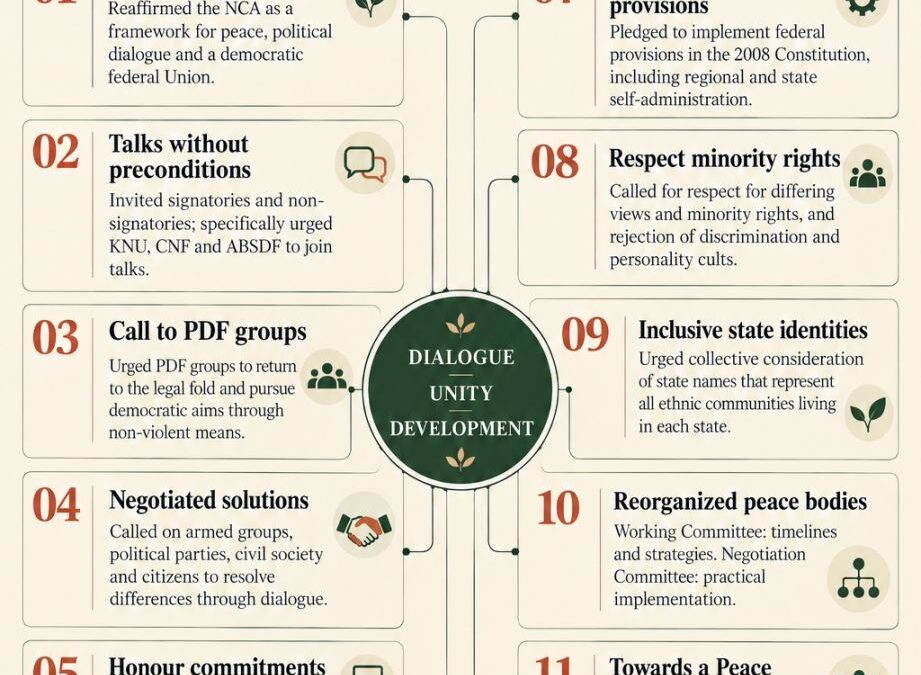
President U Min Aung Hlaing highlighted dialogue, national unity and the link between peace and development in his address marking the NCA’s 11th anniversary on 15 October 2026. He renewed invitations to peace talks without preconditions and outlined proposals on federalism, minority rights and the implementation of previous agreements. These 12 key points summarize the main messages of his speech.
The key points from the speech marking the 11th anniversary of the Nationwide Ceasefire Agreement (NCA) are:
1. NCA remains the foundation of the peace process. The President described it as both a ceasefire agreement and a political commitment to resolve armed conflicts through dialogue and build a Union based on democracy and a federal system.
2. Peace talks are open without preconditions. He reiterated the invitation to both NCA signatories and non-signatories, specifically calling on the KNU, CNF and ABSDF to participate.
3. PDF groups were urged to return to the legal fold. He called on them to pursue democratic objectives through non-violent means.
4. Differences should be resolved through negotiation. He urged armed organizations, political parties, civil society organizations and citizens to seek practical, achievable solutions through dialogue.
5. Existing peace commitments should be honoured. He called for continued implementation of the NCA and further efforts to encourage non-signatory ethnic armed organizations to sign.
6. Previous agreements will be taken forward. He said the 43 proposed constitutional amendment points and Parts I, II and III of the Union Accord would be discussed and approved in the Pyidaungsu Hluttaw and implemented in phases.
7. Federal provisions of the 2008 Constitution will be implemented. He outlined federalism as a constitutional division of executive, legislative and judicial powers, enabling regional and state self-administration.
8. Democracy must respect minority rights and differing views. He emphasized that majority rule should give due regard to minorities and called for avoiding discrimination, personality cults and treating political opponents as enemies.
9. States should represent all their inhabitants. He said states belong collectively to all ethnic communities living within them and urged joint consideration of state names that reflect this diversity.
10. Peace institutions have been reorganized. The central, working and negotiation committees will coordinate the process, with the Working Committee setting timelines and strategies and the Negotiation Committee carrying out implementation.
11. Talks aim ultimately to convene a Peace Conference. He outlined continued informal, formal and bilateral discussions to strengthen ceasefires and prepare for official meetings under the NCA.
12. Peace and development should advance together. He linked lasting peace with rehabilitation, regional development, education, healthcare and livelihoods, presenting these efforts as a responsibility to future generations.