
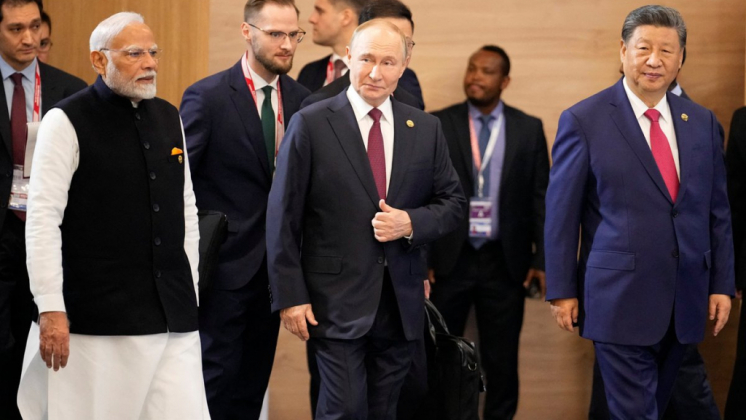
The BRICS summit in India, later this year, offers a rare opportunity to shape the global world order.
It comes at a time when the post-war world system, shaped by the Yalta Conference of February 1945, has given way to a new stage of geopolitical evolution.
Both the bipolar and the unipolar worlds are behind us, and in the third decade of the 21st century, the multipolar world order beckons.
In the now rapid transition towards multipolarity, the point of inflection has been the Iran war, triggered by the joint attack on Tehran by the United States and Israel on February 28 this year.
Contrary to the blunderous and false serial assumptions of the aggressors, such as that after the decapitation strike that killed former Supreme Leader Ayatollah Ali Khamenei on February 28, a popular revolt will be triggered that would accomplish regime change in Iran; after taking over Venezuela that has the largest reserves of oil in the world, the US will also take control of Iranian oil thereby commanding the international energy order; further expand the petro-dollar base beyond the Persian-Gulf petro-monarchies after regime change in Tehran has been achieved, Iran has stood tall, refusing to cave in to the massive US and Israeli aerial bombardment, information war and more.
On the contrary, with critical behind–the-scenes backing from China and Russia, Iran is now on the front-end of finally derailing the remnants of the unipolar world order. This is opening pathways for the emerging economies and the Global South to fix the template of a new international order.
By wrecking the US plan to take control of the global system after Iran had been knocked out, the trilateral partnership of Tehran, Beijing and Moscow seems to have worked out a game-plan to terminate step-by-step , US global hegemony, and building in its place, a new architecture of multipolar governance.
But in order to achieve its historic goal of demolishing the era of western dominance, the broad outlines of a Grand Strategy are also beginning to surface.
Apparently, according to the calculations of the trio, the attack on the US dollar that anchors the current global international financial order would be the centerpiece for developing an alternative geopolitical architecture.
That is where the expected rise of the Petro-Yuan comes in.
Being the largest consumer of Persian Gulf oil, China has leveraged its hefty purchasing power to demand its oil imports in Chinese Yuan. “Data from the World Bank shows that China accounted for over 20% of global energy demand in 2023, underscoring its market power to influence currency norms, says a Deutsche Bank report.
More specifically, recent reports reveal that China has been buying 1-1.2 million barrels per day from Iran. It is estimated that most of these purchases are paid for in Yuan.
These settlements are reportedly routed through the Chinese banks such as International Commercial and Industrial Bank of China (ICBC) or through yuan-denominated crude futures on the Shanghai International Energy Exchange (INE).
By selling its oil in Yuan, Iran bypasses US sanctions, which bar dollar transactions.
In turn, Iran has been using its Yuan earnings deposited in Chinese banks to fund specific infrastructure and development projects, many of them tied to Chinese companies and the Belt and Road Initiative (BRI), Beijing’s giant connectivity project along the ancient silk route. These include the Tehran–Mashhad High-Speed Rail– a flagship project connecting Iran’s capital to its second-largest city.
Iran has also used Chinese Yuans to finance port upgrades such as Chabahar and Bandar Abbas.
In the energy sector, China has used Petro-Yuans to upgrade Iran’s oil fields and refineries. These projects include modernisation of the South Pars gas field and refinery expansions.
Ironically, Saudi Arabia is now poised to become another major source of Petro-Yuans.
In fact, data from the Organization of the Petroleum Exporting Countries (OPEC) reveals that Saudi Arabia’s oil exports to China have surged to nearly 1.8 million barrels per day, compared to just 450,000 barrels per day to the United States.
According to the Deutsche Bank report, this fourfold difference spotlights how Saudi Arabia is now prioritising Asian markets over traditional Western destinations.
In pursuing the Petro-Yuan route, the Chinese have taken the cue from the Americans.
In 1974, the US bestowed security guarantees to Saudi Arabia, a country with the second largest reserves of oil after Venezuela. In return, Riyadh agreed that it would price its oil exclusively in dollars. Significantly, the Saudis agreed that they would recycle surplus revenues into dollar-denominated assets, such as US Treasury bonds, and make hefty purchases in the US stock markets.
Under the Petro-dollar mechanism, oil-exporting nations receiving payments recycle these dollars by parking them in dollar-denominated assets, with US Treasury securities being the safest and most liquid option,” explains a US report.
Apart from treasury securities, the oil producing countries of the Persian Gulf minus Iran also use their petro dollars to buy copious amounts of US weapons thus bolstering the US military-industrial complex. In fact, over the past two decades, sovereign wealth funds (SWFs) from oil-rich nations have also diversified into equities, real estate, and private equity, including US tech stocks.
After the Iran war began, the petro-dollar arrangement is also under severe strain because of another reason. The petro-monarchies, since 1974, had agreed to price oil in dollars because as quid pro quo, Washington had agreed to underwrite the security of these Persian Gulf countries.
But from the perspective of the Gulf monarchies, the Americans have reneged from their commitment, because Washington failed to protect them when they were attacked by Iran after February 28.
This marks a major breach of trust, which has already triggered a frantic search among Persian Gulf countries for a more reliable or a set of security partners.
This security re-calibration will take time to show up. But, early signs of change are already surfacing.
Despite the initial outrage after Iran attacked US bases in the Persian Gulf countries, these countries seem to have realised that unless something dramatic happens, it is better to engage, rather than confront Iran.
For instance, Saudi Foreign Minister Prince Faisal bin Farhan and his Iranian counterpart Abbas Araghchi spoke to each other on April 9–the first such contact after the attack on Iran.
According to the Saudi Ministry of Foreign Affairs, the two ministers discussed recent developments and explored ways to reduce tensions in order to restore stability and security across the region.
Saudi Arabia welcomed the ceasefire and expressed hope that it would pave the way for a broader and more lasting de-escalation.
The call took place amid a statement by the Saudi foreign minister that the Kingdom would have a diverse set of friends and not rely on a single partner, including the United States. Prince Faisal bin Farhan stressed that Saudi Arabia would “continue to strengthen relations with a range of partners to ensure stability and resilience in the region.”
He spotlighted that stressed that Riyadh’s security strategy has factored in partnership with Pakistan, Turkiye, China, and traditional Western allies — instead of depending solely on Washington.
Among others in the oil rich region, the Qatari foreign minister, on April 25 also held a conversation with his Iranian counterpart, signalling Doha’s shift from confrontation to engagement with Iran.
During the call with Aragchi, his Qatari counterpart, Sheikh Mohammed bin Abdulrahman Al Thani went to the extent of offering mediation to end the war, positioning Doha as a neutral party in the conflict. https://www.tasnimnews.ir/en/news/2026/04/26/3575855/iran-briefs-qatar-on-diplomatic-efforts-to-end-war
With the wheels of diplomacy turning at top speed, some of the Arab Gulf leaders are showing urgency in reaching out to Beijing. The star cast includes Saudi Crown Prince Mohammed bin Salman who held a telephonic conversation with Chinese President Xi Jinping earlier in April.
Abu Dhabi Crown Prince Sheikh Khaled bin Mohamed bin Zayed visited Beijing for an in-person meeting with President Xi. In March, foreign ministers of Saudi Arabia, Bahrain, UAE had contacted Wang Yi, their Chinese counterpart.
It has become evident that at the BRICS summit later this year, host India, in the presence of Russia, China, South Africa and Brazil, faces the challenge as well an opportunity to draw convergence between the Arab Gulf States and Iran to frame lasting stability in the Persian Gulf region. This is because Iran, Saudi Arabia and the UAE are full members of this grouping of emerging economies.
Apart from energy, India has a big stake in the stability of the region as nearly nine million Indians are employed there.
During the course of the BRICS conference, the United States will be the elephant in the room. One of the fundamental problems at the summit would be finding a pathway that would allow the peaceful co-existence between the Petro-Dollar and the Petro-Yuan.
And umbilically tied to it is the status of the Strait of the Hormuz. Unless Iran controls it, it would be impossible to implant a new international payments regime beyond the US dollar.
In anticipation of the summit and in the midst of war, India’s National Security Adviser, Ajit Doval has visited Saudi Arabia and the UAE. External Affairs Minister S. Jaishankar has also been in regular touch with his counterparts in the UAE and Iran, whereas Prime Minister Narendra Modi has spoken to Iranian President Masoud Pezeshkian.
The upcoming BRICS summit gives India and the other members a rare opportunity to elevate the status of the grouping as a leading platform to resolve thorny global problems. If successful, BRICS can become the vanguard of the new multipolar global order where the emerging economies and the global south are in pole position to set an inclusive and broad based international order.
Atul Aneja