Nay Pyi Taw- 10 April, 2025
In his address to the Union Parliament following the recent general elections, President U Min Aung Hlaing outlined the strategic roadmap for Myanmar’s new administration. The sweeping speech addresses the critical intersections of state-building and nation-building, detailing plans to solidify a multiparty democratic system and establish a federal union.
Highlighting key institutional initiatives, the President announced the formation of a Union Consultative Council, steps toward constitutional amendments, and a renewed focus on the Nationwide Ceasefire Agreement (NCA) to drive national reconciliation. Alongside these political frameworks, the address emphasizes targeted economic strategies—particularly the development of micro, small, and medium enterprises (MSMEs), agricultural modernization, and resource conservation—while calling for unified public cooperation to navigate ongoing domestic and global challenges.
The full translated text of the President’s address is provided below.
————–
Greetings to you all,
Mr. Speaker of the Union Parliament, Members of the Union Parliament, Union Government Cabinet Members, Members of Union-level Organizations, Distinguished Delegates from various countries, Ambassadors and Diplomats from foreign embassies based in Myanmar, attendees, and all citizens of Myanmar—I first extend my greetings with prayers for your physical and mental well-being, prosperity, and the fulfillment of all auspiciousness.
First of all, I would like to state that I will proudly and dutifully discharge the responsibilities of the State with utmost respect for the will of the people, as the Union Parliament, representing all citizens, has elected me as the President of the State.
In the 2020 multiparty democratic general election, the ruling party at the time committed severe electoral fraud, resulting in an unfair and inauthentic election that disrupted the essence of democracy. They engaged in dishonest politics that undermined the multiparty democratic system. Although the Tatmadaw repeatedly negotiated and appealed at various levels to resolve the issue peacefully according to the law—and in accordance with the desires of political parties and the people—these demands were ignored. Without resolving the electoral fraud, they attempted to unlawfully and forcibly seize State power by convening the parliament based on incorrect and unfair election results. Therefore, the Tatmadaw had to assume State responsibilities by declaring a State of Emergency in accordance with the Constitution and taking over the transferred State duties.
Having carried out the provisions of the State of Emergency in accordance with the Constitution step-by-step, a free, fair, and dignified multiparty democratic general election has now been successfully held in alignment with the will of the people. The respective parliament representatives are those elected with a voter turnout of 54.22% of eligible voters. Because they were elected freely, fairly, and cleanly, the legislative, executive, and judicial sectors have respectively re-emerged, and the democratic system is set to resume.
Now that our country of Myanmar has stepped back onto the path of democracy and is heading towards a better future, we must strive to build and further consolidate the multiparty democratic system. I am well aware that many challenges await our new government. I am resolute that the government and the people will work hand-in-hand to overcome challenges across all sectors, including global affairs, Myanmar affairs, politics, and the economy. Therefore, I will present the objectives, policies, and stances of the government I lead to the public through the Union Parliament, and will work effectively and successfully for the benefit of the State and the people.
Our new government will continue to implement the objectives and procedures of solidifying a genuine and discipline-flourishing multiparty democratic system, and building a Union based on democracy and federalism. In doing so, to achieve comprehensive peace, democracy, and national reconciliation, we will form and assign duties to the Union Consultative Council in accordance with the Union Consultative Council Law. As stipulated by the law, the Union Consultative Council will advise the Union Government on matters concerning the Union’s security and rule of law, international relations, peace, and legislation.
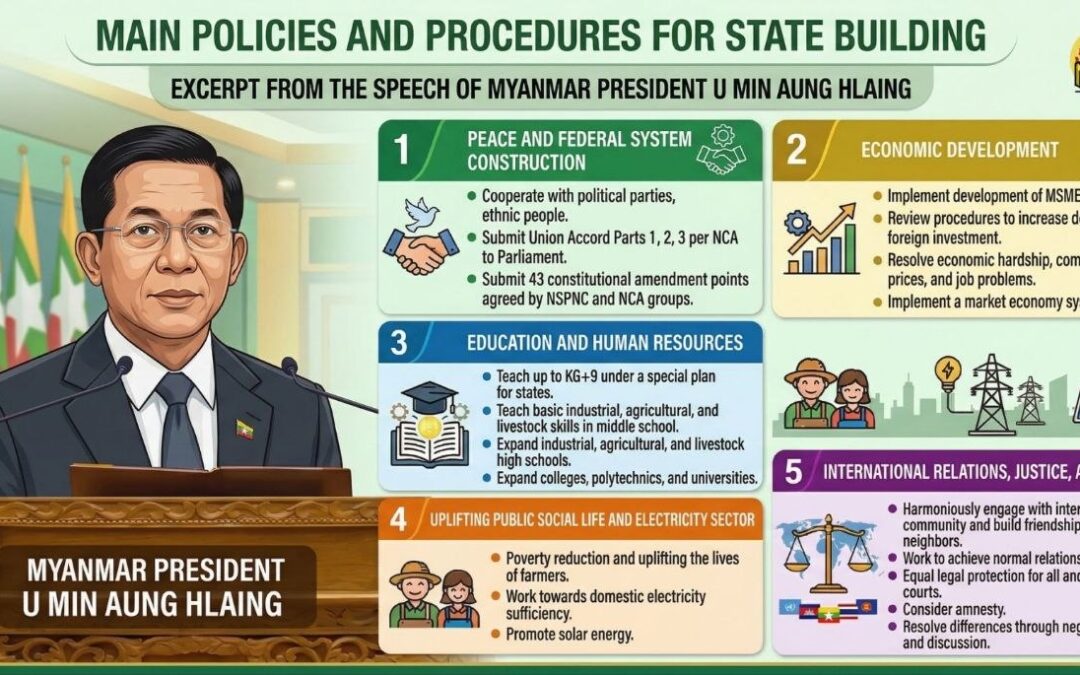
Our government will effectively implement the federal provisions prescribed in the 2008 Constitution of the Republic of the Union of Myanmar. As mentioned above, achieving peace is an absolute prerequisite for building a Union based on democracy and federalism; therefore, we will strive to realize this Union by collaborating with all political parties, ethnic people, and ethnic organizations within the country. In accordance with Paragraph 20(f) of the Nationwide Ceasefire Agreement (NCA), Parts 1, 2, and 3 of the Union Accord—discussed and agreed upon at the Union Peace Conference per NCA Paragraph 20(e)—will be submitted to the Union Parliament for discussion and approval. In addition, the 43 points agreed upon for constitutional amendment by the National Solidarity and Peace Negotiation Committee (NSPNC), NCA-signatory Ethnic Armed Organizations, and clusters of political parties will also be submitted to the Union Parliament for discussion.
We will elevate the crucial education and healthcare sectors from the fundamental level onwards for the future of the nation. We will strive to ensure that our children, students, and youth receive international-standard education and that every citizen has easy access to healthcare services. Since our country gained independence, successive armed conflicts have caused a loss of educational opportunities in some areas, including border regions, resulting in lower educational standards. Even today, ongoing armed conflicts in certain regions are depriving children of their right to education. Therefore, we will place special emphasis on upgrading the education sector uniformly, without regional disparities.
In building our country into a modern and developed democratic nation, we require many brilliant human resources, namely intellectuals and intelligentsia. Myanmar people possess a sharp intellect, and throughout history, many outstanding scholars have emerged. I want to emphasize that we must inevitably upgrade the education sector to ensure that our new generation of youth—who will shoulder the duties of the State—become globally competitive intellectuals and professionals equipped with the Five Strengths (Bala Ngar Dan). We will lay down special projects for states with weaker education systems to ensure learning up to KG+9. We will expand the teaching of basic industrial, agricultural, and livestock subjects in middle schools, as well as industrial, agricultural, and livestock high schools. We will also work towards upgrading appropriate institutes from agricultural and livestock science schools to university and college levels, and expand the establishment of Polytechnic institutes and universities.
In building a modern, developed nation, having highly educated and equally healthy, strong citizens is paramount. Our government will seriously focus on establishing effective policies for national fitness and health promotion, ensuring that healthcare initiatives directly benefit the public and provide accessible healthcare for everyone.
To revitalize the State’s economy, we will manage and facilitate the development of Micro, Small, and Medium Enterprises (MSMEs). To increase domestic and foreign investments, we will review procedures and work to accelerate business operations. We will address current economic hardships, high commodity prices, and the need for employment opportunities, and implement a market economic system suitable for the country. The main issue we face is weak production capacity. Poverty reduction and elevating the lives of farmers is a major priority for us. The majority of the rural population relies primarily on agriculture and livestock, and about 70 percent of the country’s population lives in rural areas. Therefore, we will plan and act to uplift the lives of farmers and develop rural areas. By drafting effective long-term plans and continuing to practice a market economy, we will strive to elevate the livelihoods and socio-economic life of the entire public.
Myanmar has a population of over 51 million, with women comprising about 53 percent. Throughout the nation’s history, there have been many female entrepreneurs, scholars, and heroines. To make women’s capabilities more effective across all sectors, a separate Ministry of Women’s Affairs will be established and assigned respective duties.
Given the natural disasters and severe climate changes occurring globally today, conserving natural resources and the environment is critical. Our nation is rich in forests, rivers, lakes, biodiversity, and natural resources. As we face the challenges of global warming and climate change, protecting these resources is an essential task for the survival of humanity and all living beings. To reduce deforestation and carbon emissions, we will work on utilizing environmentally friendly renewable energy.
Although the current Middle East conflict has seen a temporary halt in armed clashes for two weeks, we must monitor how it will unfold. Regardless of the situation, fuel difficulties will persist; therefore, a country like ours, which imports approximately 5 billion USD worth of fuel annually, must inevitably practice fuel conservation. It is best to reduce consumption as much as possible in areas such as vehicles and generators. It is absolutely necessary to generate electricity from renewable energy and utilize electric vehicles as much as possible. As national development is directly linked to the electricity sector, we must strive to meet domestic electricity demand. We must also promote the development of solar energy.
The Ayeyarwady, Chindwin, Sittaung, and Thanlwin rivers are the main lifebloods of Myanmar, playing a crucial role in agriculture, freight transport, and hydropower generation. Freight transport along the rivers can be done cost-effectively and utilized for agricultural water supply during the rainy season. Similarly, we will manage river water pumping projects and cultivation along the banks of the rivers during the summer. We will strive to effectively utilize the Ayeyarwady and Chindwin rivers, which support extensive transportation, across all seasons. To facilitate smooth public travel, we will expand public transportation services that operate on regular routes with fixed rates.
We will conduct balanced international relations and build closer friendships with neighboring countries. As our country is an ASEAN member state, we will endeavor to restore normal relations with ASEAN. We will cooperate with neighboring and regional friend nations in political, economic, and social sectors, and solidly build international relations in accordance with the Five Principles of Peaceful Coexistence.
Our government will prioritize ensuring that every citizen receives equal protection under the law, preventing wrongful convictions, delivering fair, precise, correct, and swift justice where crimes and punishments are proportional, and ensuring the integrity of the courts. The rule of law is a vital foundation for a country’s stability, peace, and development. To support social reconciliation, justice, peace, and national development, our government will also consider granting appropriate amnesties.
In conclusion, the government I lead will set objectives and work towards consolidating the multiparty democratic system, building a Union based on democracy and federalism, developing the nation, and elevating the socio-economic life of the people. I believe that the entire public, in cooperation with the government, can overcome these tasks and the challenges our country currently faces through unity. As the saying goes, “The strength of the nation lies within,” success can only be achieved with the collaborative participation of all ethnic people. Therefore, I invite political parties, civil society organizations, business owners, ethnic organizations, and all citizens to join hands and cooperate. We will view our differences not as weaknesses, but strive to achieve good results through negotiation and collaborative problem-solving.
Though there may be various differing views and beliefs, we are all brothers and sisters born of this same soil. Therefore, I conclude by expressing my firm belief that with our unity and perseverance, we will successfully march towards our shared goal.
Thank you all.