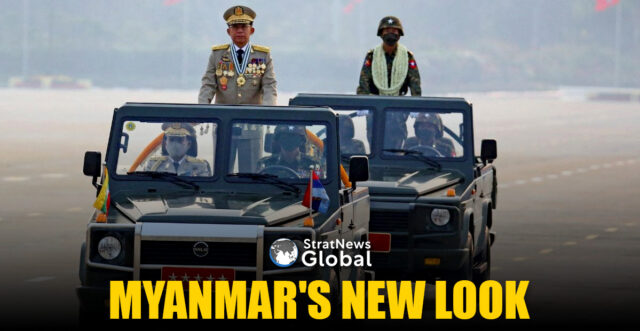
Is the army ready to change its spots and be more accommodating of people’s aspirations?
By Atul Aneja – April 7, 2026
After battling more than five years of a bitter western-backed insurgency, Myanmar appears set for a new beginning.
Senior General Min Aung Hlaing, the face of the resistance against externally backed Ethnic Armed Organisations (EAOs), and affiliates, has been elected by a brand new parliament as president. His ascent followed month-long parliamentary polls that began in Myanmar towards the end of December 2025.
Critics have labeled the ongoing elections as a sham, pointing out that free and fair polls were impossible due to violence raging in many parts of the country and the decision by the National League of Democracy (NLD), still on paper led by Aung San Suu Kyi, to boycott the polls.
Nothing could be farther than the truth. Before raking mud at the government, these analysts have to understand that elections in Myanmar have, since its independence, always been held in troubling political contexts, and have never been perfect. This one was no exception.
Take for instance the 1951 poll, Myanmar’s first founding elections. It took place at a time when the country was encountering multiple insurgencies that had immediately followed Myanmar’ independence in 1948.
The post-independence government of U Nu was labeled as the “Yangon Government,”as it was unable to extend its writ beyond Yangon, the former capital.
But in a bold counteroffensive that was launched in 1950, government forces succeeded in wresting control over major urban centres. Here India supported Myanmar in coordinating cross border patrolling and stemming the flow of Naga and Mizo tribesmen into Myanmar from the northeast.
Consequently, a decision was taken to hold elections as promised in 1951. Those landmark elections too were held in three phases, but lasted an extended period of over fourteen months. Starting in June 1951 they concluded in April 1952.
However, polls could not be held in many border zones, where ethnic states had been formed. In fact, polling failed to materialise in nearly 11 per cent of central Myanmar’s regions due to fighting. But, despite the odds, U Nu’s Anti-Fascist People’s Freedom League, won handsomely. A decade of peaceful and prosperous democratic rule followed.
Fast forward to 2010, when another imperfect but highly consequential poll took place. In that year, the military-led State Peace and Development Council (SPDC) convened elections, following the adoption of the 2008 Constitution through a referendum.
Skeptics then too slammed those elections, which were being held after decades of military rule. National morale too was quite low, as the people had been suffering from the aftermath of super cyclone Nargis.
Amid the pessimism, some major political parties including the NLD boycotted these elections. In fact, polling could not be held in the entire Wa Self-Administered Division.
But beating all odds, these elections yielded the government led by U Thein Sein, who assumed office in 2011. The Thein Sein administration introduced path breaking 360-degree reforms covering political, economic and humanitarian domains.
Consequently, for another decade, Myanmar plugged into the international mainstream. Foreign investments poured in imparting forward momentum to the economy. Besides, political stability returned following the “Nationwide Ceasefire Agreement” with eight Ethnic Armed Organisations (EAOs).
Though the international context has entirely changed–the western dominated uni-polar world hurtling towards multi-polarity now– the 2025 elections do faintly echo the 2010 situation.
Several international organizations say the polls are not credible as the majority of the country’s remote regions are still engulfed in serious armed conflicts.
Yet, it is important to peer through the international media haze in order to evaluate the factual situation. For instance, the State Security and Peace Commission (SSPC) held elections in 265 townships. This is a big success as it covers 80 per cent of the total 330 townships in the country.
The 2024 national census shows that only 13 per cent of the total population lives in the 65-townships where elections have been cancelled.
Not only are these 65 townships sparsely populated because of their remote location, they have also suffered heavy migration to neighbouring countries due to the conflict, further reducing the population density there.
According to the narrative pursued by the so-called “international community”, the latest elections are illegitimate because they are rooted in a so-called military coup mounted by the recently elected President.
This is a mischievous argument which deliberately ignores the provisions of Myanmar’s 2008 constitution that was invoked to remove and arrest Aung San Suu Kyi, the supposed winner of the 2020 parliamentary elections.
Understanding the context about the February 2021 military takeover and details about Myanmar’s basic law is imperative.
The 2020 polls took place when the second wave of Covid was raging. This health emergency was bound to negatively impact campaigning. Besides, the military contested the 70 per cent turnout figure declared by the previous election commission, that too overwhelmingly favoring Aung San Suu Kyi’s National League for Democracy (NLD).
In fact, the military argued that millions of voter names were inaccurate on electoral rolls, and claimed that advance voting and postal ballots was manipulated. It demanded a rerun of the elections, or a recount, which was not granted.
“In 2020, one-third of the eligible votes were fake. In polling stations there was no need to show ID cards. Around 11 million voters were fake,” Ko Ko Hlaing, an adviser to the former Senior General, now President told this writer.
He added: “The commander-in-chief tried to negotiate midnight before. The NLD rejected all compromises. The C-in-C offered postponing declaration of election results so that fact-checking could take place before a new parliament could convene.”
The military also apprehended that serious attempts were underway to amend the constitution, which requires a difficult-to-muster but not impossible 75 per cent majority, provided some law makers holding the 25 per cent seats reserved for the military break ranks.
For instance, in 2019-2020, the NLD had proposed amendments which included a reduction in the guaranteed military quota from 25% to 5% over time. Besides, it sought to remove a provision in the 2008 constitution that barred anyone with foreign family members from becoming President.
This clause was directly impacting Aung San Suu Kyi, whose late husband and children are British citizens.
Consequently in February 2021, the military, under its then commander-in-chief Min Aung Hlaing assumed power, invoking Article 417, Article 418 and Article 420 of the 2008 constitution.
Article 417 allows the President to declare a state of emergency if there is a threat of disintegration of the Union, loss of sovereignty, or attempts to take power by unlawful means. Once declared, the Commander-in-Chief of Defence Services assumes all state power.
Article 418 on the other hand transfers legislative, executive, and judicial powers to the Commander-in-Chief during the emergency, while Article 420 grants the military authority to administer the country until the emergency is resolved.
With the military now exercising dominance in much of the heartland, mainly because of massive deployment of drones, air strikes and manpower expansion, Myanmar authorities felt comfortable enough to order elections and return to civilian rule under the 2008 constitution.
In tune with the success of the latest poll, followed by the election of the new President, Myanmar has reasons to look forward to a better future.
As the post-election phase dawns, both the houses that have converged has elected former Senior General Min Aung Hlaing as the new President. He will shed his previous positions.
Having weathered the storm of a vicious externally backed insurgency and imparting political stability, it is anticipated that the newly anointed President will leverage his experience, discernment, organizational capabilities, and diplomatic rapport with major partner nations to steer the reconstruction of Myanmar into a stable regional state.
During the five years of emergency, Myanmar’s leader had fully grasped that the uni-polar world led by the United States was rapidly giving way to multi-polarity. In tune with the global shift Myanmar’s foreign policy under him pivoted towards Russia, China and India–three civilizational states that are likely to anchor the multi-polar world.
Along with this troika, Myanmar warmed up to Belarus, a country that was close to Russia but whose leader Lukashenko, like Viktar Orban of Hungary had a close personal rapport with US President Donald Trump. In other words the the leader of Belarus could provide a first rate channel to influence the US President.
Besides, on Min Aung Hlaing’s watch, Myanmar had opened diplomatic channels with the Shanghai Cooperation Organisation (SCO) and sought membership of the BRICS+ grouping.
In the post-election phase, Myanmar’s President has established a competent core team to advance the country’s national goals. They include First Vice-President U Nyo Saw, a retired General with a reputation for strategic thinking and deep influence in Myanmar’s economic sector.
The Second Vice-President is Daw Nan Ni Ni Aye, an ethnic minority representative. She is expected to make significant strides in promoting ethnic reconciliation and enhancing social welfare, healthcare, and the development of women and children.
Furthermore, it is anticipated that the President may form a National Advisory Council to provide strategic advice on administrative, defence, and security matters.
While serious challenges remain, there is considerable optimism that Myanmar is driving pillars of hope for its future. If the President’s plans are well executed, including turning the country into an international hub of Theravada Buddhism, Myanmar, which borders India, Bangladesh, China, Laos and Thailand can majorly contribute to the stability of the entire Indo-China region.
Atul Aneja is a veteran journalist who has covered some of the world’s hot spots including West Asia and China
Source: Stratnewsglobal.com