
The ASEAN Charter is the legal foundation that binds Southeast Asia to ensure regional peace, stability, and development. By clearly defining the ethics and obligations that every member state must equally adhere to, the Charter enables ASEAN to stand firmly on the global stage as an organization that prioritizes and strictly follows a rules-based system.
Specifically, the policy of “non-interference in the internal affairs of one another” is the key to building mutual trust among member states. This policy not only protects the sovereignty of smaller nations but also prevents conflicts between diverse political and social systems. By maintaining this balance, it remains indispensable to regional security.
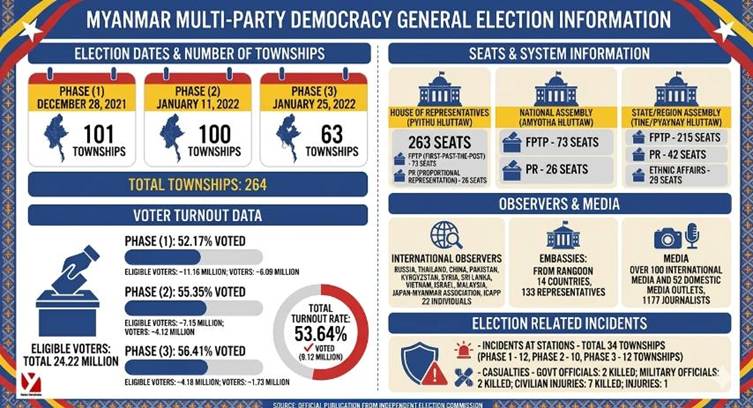
If we observe the current political progress and positive shift in Myanmar, the efforts to ensure democracy takes firm root in the country are clearly visible. A free and fair multi-party democratic general election was successfully conducted in the Republic of the Union of Myanmar from December 2025 to January 2026. Out of a total of 24.22 million eligible voters nationwide, over 13.14 million citizens (54.22%) cast their ballots with dignity and according to their free will. Consequently, a Parliament chosen by the majority of the voting public, and a government led by the President elected by that Parliament, have been successfully established.
When reviewing the background of why this new election had to be held, it becomes evident that the then-incumbent government committed severe electoral fraud during the 2020 election. As political parties and the public firmly asserted that the election was unfair, authorities conducted official investigations. These probes clearly revealed over 11.3 million instances of voter list errors and irregularities out of more than 38.2 million eligible voters. This has been recorded as a case of extreme electoral malpractice in the history of Myanmar’s elections. Consequently, in order to uphold the rule of law and national justice, these fraudulent activities had to be addressed and resolved in accordance with existing legal procedures.
Furthermore, it was firmly established through evidence that the NLD government officials—who sought to seize state power through dishonest means such as electoral fraud—also committed other legal violations, including corruption. Consequently, the relevant courts passed down convictions in accordance with existing legal procedures. Consequently, the Tatmadaw was compelled to assume state responsibilities in line with the 2008 Constitution and implement a roadmap to ensure the preservation of the multi-party democratic system desired by the people. A key component of this roadmap was the successful holding of a new free and fair election in December 2025, aimed at restoring the country’s democratic mechanism to its proper function and reflecting the genuine will of the people.
Just as some other countries in the region have seen their militaries temporarily assume state responsibilities to strengthen the democratic system based on their own domestic conditions, Myanmar’s political process was similarly conducted in accordance with its national sovereignty and prevailing constitution. Based on the reality on the ground, it must be recognized that the current government was established by the People’s Assembly (Pyithu Hluttaw), which itself was elected by the majority of the public through a free, open, and fair multi-party democratic election.
While the majority of ASEAN member states has a clear understanding of Myanmar’s correct and positive political progress and wish to enhance cooperation by working together for regional interests, a few members continue to ignore these positive developments. These nations persist in their efforts to impose restrictions, practice discrimination, and exclude Myanmar from equal representation within the ASEAN community.
Since Myanmar first joined ASEAN in 1997, the country has actively participated in ASEAN processes in accordance with the group’s consensus. As a responsible member state, Myanmar has consistently fulfilled its duties, including the regular payment of annual contributions to ASEAN mechanisms and activities. Although some ASEAN nations have practiced discrimination against Myanmar over the past five years, Myanmar has remained patient and cooperated as a good member state. However, attempting to persist with these non-constructive, discriminatory practices into the term of the new government disregards the will of the Myanmar people who cast their votes through democratic means.
Lately, it is clearly evident that some ASEAN member states are increasingly interfering in and encroaching upon Myanmar’s internal affairs and its independent judicial sector. A prime example can be found in the remarks made by Philippine President Bongbong Marcos during a press conference on May 8, 2026. In that briefing, President Marcos called for the release of Daw Aung San Suu Kyi and the upholding of her rights; he further asserted that if she is recognized as a leader, she should be granted the authority befitting her position.
Furthermore, he remarked that these points could be considered as a main ASEAN demand in negotiations with the Myanmar government, emphasizing that there would be no change in this stance. In reality, a nation’s judicial system is a vital component of its sovereignty; it is a process in which no foreign country has the right to interfere.
The Philippines’ statement is merely an attempt to place above the law an individual who has been charged, tried, and sentenced in accordance with legal procedures by the relevant court for violating Myanmar’s existing laws. This constitutes direct interference in Myanmar’s sovereign independent judicial power and its rule-of-law processes. Such actions violate the fundamental ethics to be followed in international relations and significantly damage the mutual respect that must be maintained among ASEAN member states.
Furthermore, this action is a flagrant violation of ASEAN’s vital “Non-interference” principle, explicitly stipulated in Chapter (1), Article (2), Sub-sections (2-a) and (2-e) of the ASEAN Charter: “to respect the sovereignty of member states” and “non-interference in the internal affairs of one another.”
In the field of international diplomacy, mutual respect is the most essential foundation of any relationship. However, President Marcos’s disregard for diplomatic ethics and his direct encroachment upon Myanmar’s internal affairs and judicial sector openly challenge the core principles of “mutual respect” and “non-interference” that ASEAN has firmly upheld for many years. Conversely, on March 11, 2025, the Marcos administration permitted the arrest of his political rival, former President Rodrigo Duterte, by Interpol at Ninoy Aquino Airport, citing an International Criminal Court (ICC) warrant. This action drew intense domestic and international condemnation as a political misuse of the Philippine democratic system and judicial authority.
Regarding this sensitive and delicate matter, Myanmar exercised diplomatic maturity and remained silent, treating it solely as an internal affair of the Philippines. Myanmar refrained from making any comments, interferences, or condemnations regarding the arrest of former President Duterte, strictly adhering to the policies of the ASEAN Charter and maintaining diplomatic dignity.
However, the “Double Standards” currently displayed by the Philippine President not only infringe upon Myanmar’s sovereignty but also damage and create cracks in ASEAN unity. Myanmar will absolutely not accept any form of external pressure or dictates and will continue to firmly protect the national interest and sovereignty. Furthermore, the Philippines should respect and follow ASEAN’s fundamental principles and contribute only through constructive means toward regional peace and stability.
The baseless demands made by the Philippines represent a self-serving manipulation of the ASEAN Charter and clearly demonstrate a lack of genuine desire for regional stability. For ASEAN to remain a strong, rules-based organization, all member states must strictly adhere to the principles of the Charter to which they have collectively signed.
Disregarding the ASEAN Charter and interfering in the internal affairs of another member state, or committing acts that destabilize the region, constitutes a severe blow to the unity of the ASEAN family. Such violations not only damage the mutual trust painstakingly built between member states over many years but also significantly weaken ASEAN Centrality on the international stage.
Regarding the current ground realities and ASEAN’s policy of neutrality, it is observed that Myanmar successfully held free and fair multi-party democratic general elections between December 2025 and January 2026. The legitimate government, led by the Parliament and the President elected by the people through democratic means, is now fully implementing administrative machinery and rule-of-law processes nationwide. It is of the utmost importance for ASEAN to view these realities objectively, correctly, and without bias.
ASEAN is merely a mediator and is strictly prohibited from directly interfering in the internal affairs of its member states. Therefore, the ASEAN community must firmly uphold the principle of Neutrality, which is the fundamental cornerstone for fostering regional peace and cooperation. Any ASEAN’s involvement regarding Myanmar’s affairs must be based solely on the actions of the current legitimate government and the actual situation on the ground.
While a full consensus regarding Myanmar has not yet been reached within ASEAN, Myanmar continues to engage with individual member states. Sincere gratitude is extended to the majority of ASEAN nations that have understood and supported Myanmar’s positive developments. Most importantly, Myanmar will continue to firmly implement processes for peace, stability, national prosperity, and the protection of the basic rights and interests of its citizens through a “Myanmar-owned and Myanmar-led Process” that is suited to the country’s specific needs and ground realities.
While the international community may appeal for clemency on humanitarian grounds for an individual serving a sentence under existing national laws, they have no authority to demand the restoration of a leader’s rights and powers to that individual. ASEAN’s role is limited to mediating conflicts; making overreaching demands while ignoring current ground realities does not reflect constructive goodwill, but rather constitutes coercive interference.
Adhering to the principles of the ASEAN Charter is not a choice, but a mandatory obligation for every member state. Any action that harms regional stability or basic rights under the pretext of internal affairs must be prevented through the collective strength of ASEAN unity. Only by strictly following these rules can we successfully realize the ASEAN vision of “One Vision, One Identity, One Community.”